

“You keep using that word. I do not think it means what you think it means.” These are the immortal words of Inigo Montoya from one of the most quotable movies of all time, The Princess Bride.
As anyone who has ever seen the movie knows, he is reacting to Vizzini’s overuse of the word “inconceivable!” He only says it five times, actually (no, I didn’t count; I looked it up) but the timing of each use leaves you feeling like he used it a whole lot more than that. Inigo sure thought so.

Christianese is replete with such tropes and cliches. We are quite fond of grabbing a term, often out of context, and bandying it about to the extent that the term has lost clear meaning.
Suppose you are sitting in church and the preacher, either in the sermon or at the close of the service encourages you to go out and “live victoriously” this week. The fact that you are encouraged to go out and do something like that implies that you have work to do.
What would your response be?

You might be left wondering exactly what he means by that, shrug it off because you aren’t sure and move on with your life. Or, you might think to yourself that you are feeling pretty “victorious” lately, so you go into your week keeping up the good work. Or, you might decide that he is asking you to work on things in your life so you go into your week trying hard to, say, better demonstrate the fruit of the Spirit. Or, you might even feel like you have not been very “victorious” in life lately. You feel discouraged when you hear the challenge and by week’s end, you are feeling like a failure indeed because you have not made any progress in the Christ-likeness department. “Victory” seems unattainable so you are discouraged.
The idea of being “victorious” sounds great and is even biblical. To endeavor to gain “victory” over, say, an addiction, is a good thing provided you are not trying to do so in order to make God happy or to change your standing with Him or His view of you.
The truth is, as a believer in Jesus Christ, His blood has been applied to you, and the Father cannot be any more pleased with you than He is right now. You cannot do anything to make Him more pleased or any less pleased because He is pleased with His Son and Jesus’ righteousness was placed on you as if it were your own.
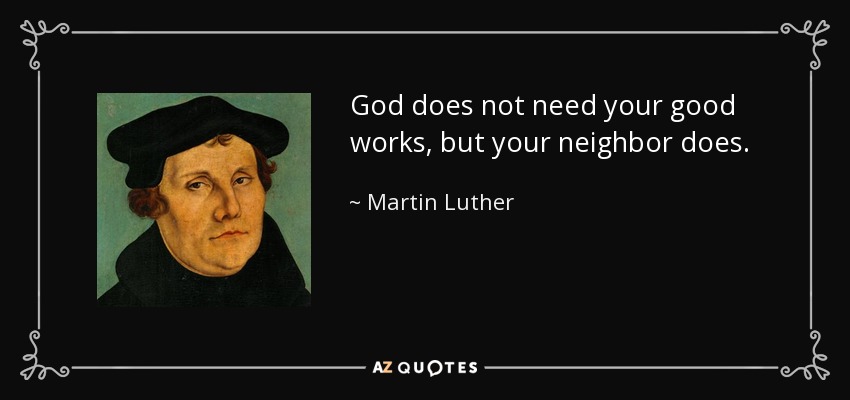
So, don’t go out and try to gain “victory” over any sin for God to please Him. Jesus already did everything that can be done to please Him. To try to gain “victory” over those things for your sake and for the sake of others is a good thing. Sin is not good for you, and it often affects others poorly. As Martin Luther once rightly said, “God doesn’t need your good works, but your neighbor does.”
But, here’s the problem with the charge to go out and live “victoriously.” Normally, the above clarifications are not made, mostly because the pastor himself may not understand the clarification.
The hidden curriculum that comes with the charge to “live victoriously” is that it attaches the biblical concept that we have “victory in Jesus” with something that we need to go out and accomplish, and that we are falling short of the “victory” by our failings in life.
I have been guilty myself of throwing around cliches and tropes because that’s what we do. I had no idea that I was degracing those who trusted me. I was robbing people of the opportunity to live in the grace that was theirs to enjoy, Whether explicitly or implicitly, I regularly gave the impression that we actually have the ability to gain “victory” over sin, which meant that we now had the ability to stop sinning, at least theoretically.
Using that dangerous logic, if I were to go out and sin less this week, I would be more “victorious.” If I were to sin more, I would be less “victorious.” What that did was put myself and others on the treadmill of performancism by making change our responsibility. Don’t get me wrong. I have the responsibility to do right. It is on me to respond obediently to the Lord in any given moment for the sake of my neighbor. But change occurs not by my will or power but by the power of the Spirit. In the interest of space (and your attention span), however, this is a topic for another blog.
In simple terms, a study of Scripture will show that we, as believers in Jesus, are given Jesus’ “victory” and that “victory” has nothing to do with anything we have done or ever can do. We cannot live any more or less in that “victory” than we do right now.
The Greek word that is translated in our English Bibles as “victory” is nikao (νικαω) which is more often translated as “overcome” or even “conquer.” The most glaring thing to notice when studying each occurrence is that, no where are we told in Scripture to “be victorious.” There is no sense in which we are commanded to do anything regarding the “victory” that is already ours.
We are told to “overcome” only once, in Romans 12:21 where Paul tells the Romans not to be “overcome” by evil, but to “overcome” evil with good. The context has to do with not repaying the evil that another person does by being evil back at them. He is telling them to be “victorious” over this evil by being “good” to the one who hurts you.
If I were to be preaching on this passage and I were to exhort you to go out and “be victorious” this week from this context, that would be appropriate. This “victory” is not related to any “victory” that I have in Christ.

Perhaps one of the most famous places where we find the term is in 1 Corinthians 15:57 (but thanks be to God, who gives us the victory through our Lord Jesus Christ.) As always, context is very important and we must ask what the “victory” is over before we take the verse and run with it.
In this lengthy and well-known chapter, Paul is addressing the issue of resurrection which was apparently being doubted among the Corinthian church. He points out that, if there is no resurrection, then even Jesus was not raised from the dead and our entire Christian faith crumbles to the ground.
In his discussion on Jesus’ resurrection, he says that He will one day “conquer” all of His enemies; at which time He will hand over the reins back to the Father. The last enemy to be “conquered” (v 26) is death. He then takes about 30 verses to show how this happens but the point is finally made at the end of the chapter, that the same “victory” that Jesus scored over death is our “victory,” as well.
Ultimately, he is talking about our eternality. The fact is that Jesus made death powerless at the cross and that same “victory” is given to us. Practically speaking, we do not experience that “victory” yet, but we have received it by faith. We know that it is coming, so it is as good as ours. Jesus suffered death but rose again. We believers will suffer death (unless, of course, He returns before then!), but will rise again.
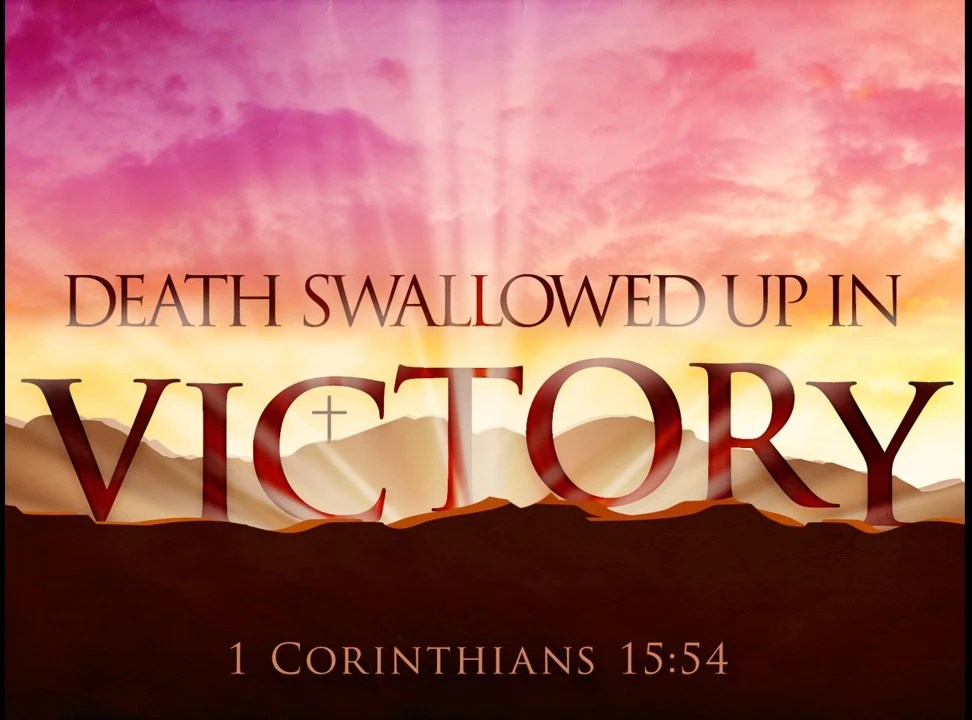
The point is that the “victory” is given to us. Jesus won it and shares it with us. Once the “victory” is mine there is nothing I need to do or can do about it. I am a victor just as He is.
Another place where the idea is found is in the famous Romans 8 passage in verse 37 (But in all these things we overwhelmingly conquer through Him who loved us). The words “overwhelmingly conquer” are actually one word in Greek. It means to be uber-“victorious.”
Again, context first. To what does “these things” refer? Paul is referring to the list he just gave in verse 35 (“Who will separate us from the love of Christ? Will tribulation, or distress, or persecution, or famine, or nakedness, or peril, or sword?”) It is over these things that we are uber-“victorious.”
Wait a second. If we have “conquered” these things, how is it that we still experience these trials and tribulations in life? Certainly, Christians have suffered these things over the millennia.
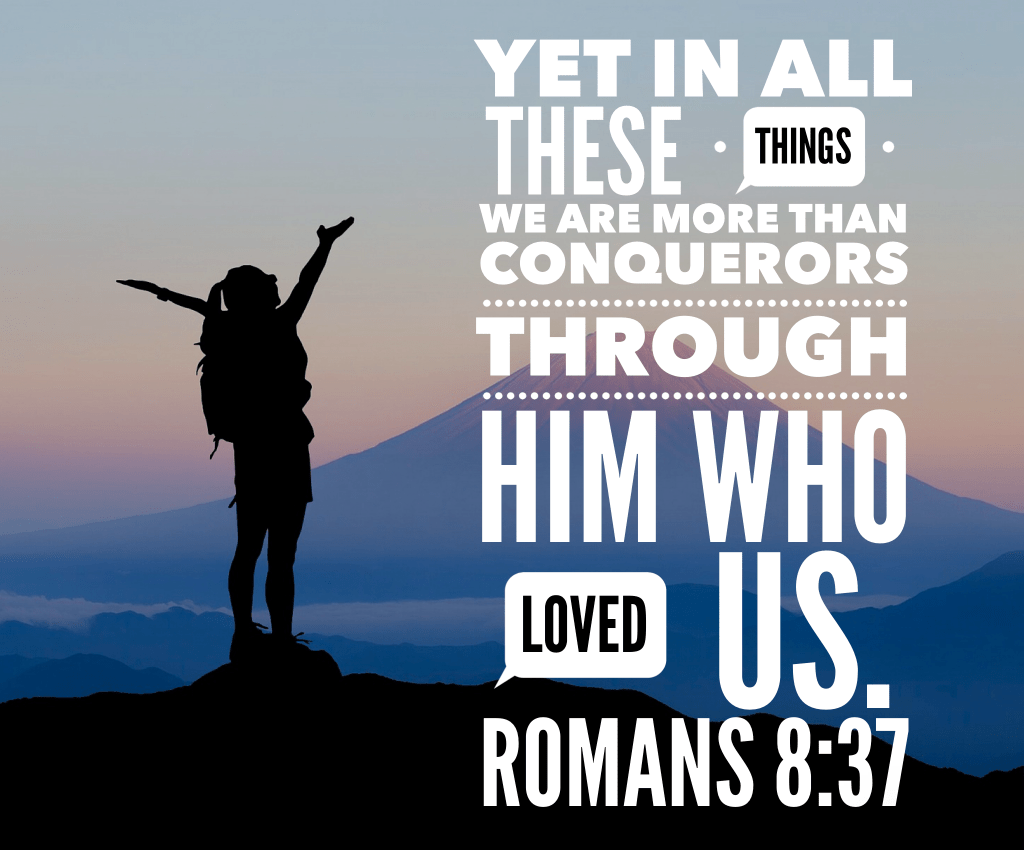
This highlights an important issue. To “conquer” them does not mean that they no longer exist in our lives. There is no sense in which our “victory” removes them from our lives. What has happened is that we have mistakenly dragged our understanding of “victory” (that this “victory” means that what was defeated must have been removed from the scene) into this biblical context. So, when we are challenged to “go out and live victoriously,” and then still we experience these things in our lives, we conclude that we must be doing something wrong.
The fact is, “victory” over these things means that, even though they may afflict us in life, they can never separate us from the love of Christ which Paul spends that whole chapter telling us about, starting with verse 1 where he says “therefore there is now no condemnation for those who are in Christ Jesus.”
Like the “victory” over death (1 Corinthians 15) we may experience what seem like defeats in battle, but the war itself is already won. And the “victory” is already ours because Jesus already won the “victory” for us.
Jesus states that rather explicitly in John 16:33 (“These things I have spoken to you, so that in Me you may have peace. In the world you have tribulation, but take courage; I have overcome the world.”)
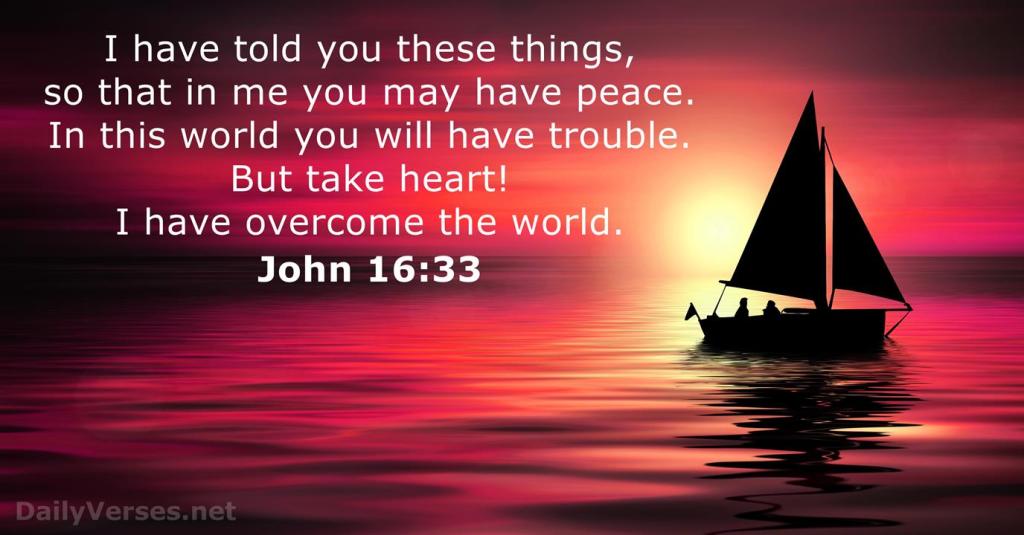
He is clearly telling His disciples (and us by extension) that they would experience losses in battle, but that He had won the war. He hadn’t died yet when He said it, but His point was that His “victory” was imminent and as good as won.
John uses “νικαω” (the Greek word behind it all) several times in both his first epistle (5 times) and in Revelation (12 times). The epistle, 1st John, can be rather frustrating to read because you really have to be patient and stick around sometimes to figure out what he is really talking about, but by the time you have read the whole thing there are at least two things to note.
First, the “overcoming” is done by Jesus over Satan and the world that he rules. Second, that “victory” is given to us based on our faith in Jesus. It is that simple. The only thing we do to be “victorious” is to believe in Jesus for our salvation. It is a once and done thing! He defeats Satan and thus, we win with Christ.
The “conquering” motif continues in the last book of the Bible, Revelation, where a very powerful scene is depicted at the throne of God the Father Who holds a scroll that no one is found worthy of opening—except One.
In chapter five, one of the elders tells John not to worry. There is One Who is worthy. It is none other than Jesus, the Lion. John looks and sees not a lion but a Lamb Who had been slain but was now standing there very much alive!
This very Lamb, Jesus, the Lion of the tribe of Judah, had “overcome” by His death and resurrection and was deemed worthy to open this scroll.

This is the central focus of the book, that despite all that will occur—indeed the culmination of time—Jesus has “overcome,” and all who taste of the “spring of the water of life” (Revelation 21:6-7), all who have been redeemed, will “overcome.”
My point in all of this? If you believe in Jesus as your Savior, you already have, by grace through faith, been given Jesus’ “victory” over Satan and death. To believe otherwise is to believe the age-old lie that started way back in Genesis 3 where Satan put doubt into the hearts of Adam and Eve by saying, “Did God really say…?”
If ever you are told to “go out and live victoriously” and the implication is that you need to somehow do better for God, you are being fed a form of the same lie, calling a promise of God into question.
Did God really say that you are already as “victorious” in Christ as you will ever be? You bet He did! Don’t let trials in life cast that kind of doubt. Don’t let your shortcomings cause you to believe that you need to work at being “more victorious.” Jesus has already done that for you and you have nothing more to do!
Now, that is inconceivable!!
The “overcoming” is done by Jesus over Satan and the world that he rules. Second, that “victory” is given to us based on our faith in Jesus. The only thing we do to be “victorious” is to believe in Jesus for our salvation.
Tweet
Discover more from Revived By Grace
Subscribe to get the latest posts sent to your email.

 Revived By Grace
Excellent clarification! Praise God that He is my Victor!
LikeLike